Minimalism Didn't Die. It Grew Up Into Intentional Living
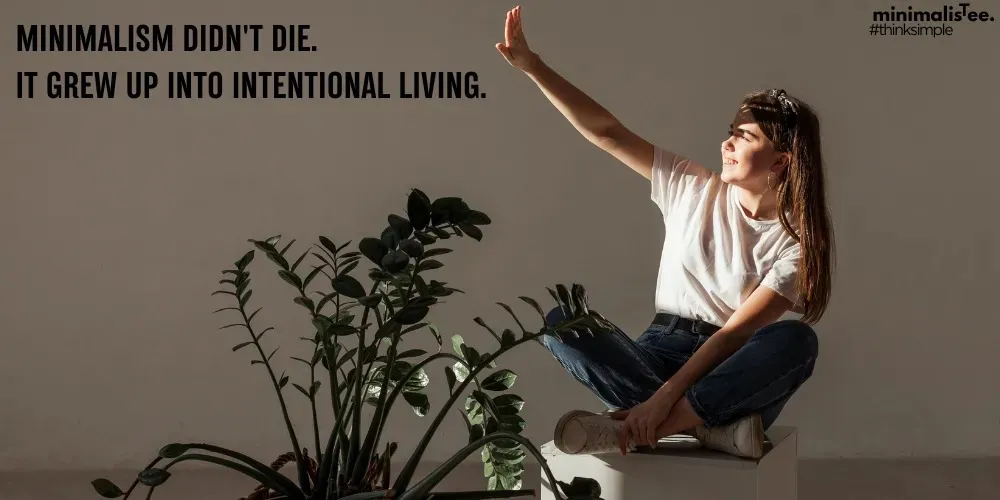
Minimalism didn't die. It grew up into intentional living.
Intentional living. It does sound heavy if you suddenly just look at it while doing some work or being super busy. But once you actually take a pause and try to understand its real meaning, you get to live it.
Yes, live an intentional life that not only adds value but also teaches you to focus on what really matters.
But wait. Before that, let's clear the confusion about the claims that minimalism is dead in 2026.
Open your Instagram account, and somewhere between the latte art and the travel reels, you will find a beige room, two succulents, and a single book on an otherwise empty shelf. Many people call it minimalism.
And somewhere else, someone’s writing a think-piece about how minimalism is changing their lives and teaching them to breathe again. They also say this is minimalism.
But the truth? Both of them are talking about the wrong thing.
Minimalism was never about owning fewer things. It was always about owning your choices. We just got distracted by the aesthetics.
Here is what actually happened: minimalism as a trend peaked, got commodified, and soon got into the debate of whether it is still alive or dead. But it was never about being dead or losing its weight in this loud world of consumerism. Minimalism quietly handed the baton to something more honest called intentional living. And if you have ever felt that ‘less is more’ was never really about your furniture, you already know what that means.
The trend is over. Good.
Let’s be honest about what the minimalism aesthetic gave us: a lot of white walls, a guilt trip about owning too many clothes, and a vague sense that if your home didn’t look like a Scandinavian hotel lobby, you were doing life wrong.
The trend attracted people for the right reason — everyone was exhausted by the clutter, the noise, the overwhelm. But it sold them the wrong solution: a look instead of a practice.
So, when people say minimalism is dead, what they actually mean is: the aesthetic is tired. The philosophy? That’s not going anywhere.
What does intentional living actually mean?
Intentional living is what minimalism looks like when it grows up. When it stops being about the number of items in your wardrobe and starts being about the quality of decisions you make every day.
In simple terms, intentional living is the practice of making conscious choices about how you spend your time, energy, money, and attention so that your life aligns with your values.
Intentional living asks one question before almost anything else: Does this add value to my life, or is it just adding noise?
That question applies to your calendar. Your relationships, spending, phone screen at 11 pm, and also your career commitments. It extends to your emotional habits.
It’s not a visual style but a way of thinking. And that’s precisely why it’s more durable than any trend.
What does minimalism vs. intentional living look like?
| Minimalism (Trend) | Intentional living (Evolution) |
| Focus on fewer things | Focus on better choices |
| Aesthetic-driven | Value-driven |
| External | Internal |
Why is this shift happening right now?
We are living in the most over-stimulated, over-committed, over-communicated era in human history. And collectively, we are starting to feel it. According to Deloitte’s 2023 Global Survey, 77% of professionals report burnout at their current job.
The numbers tell an interesting story:
- Burnout is at an all-time high, especially among professionals under 40.
- Screen time keeps rising, even among people who know it’s a problem.
- Anxiety around money, career, and relationships is being reported across every generation.
Ironically, none of this can be solved by owning fewer shoes. So, what you really need is for your problems to be addressed by choosing what you let into your life with more deliberateness.
And that is why intentional living is resonating so powerfully right now. It doesn’t ask you to become a monk, but instead to become conscious about what you consume.
Read me: Work Burnout Is A Signal. Minimalism Is The Response.
Three signs you are already living intentionally (without knowing it)
You don’t need a label for it, and if any of this sounds like you, you are already practicing it:
- You have started saying no to things that don’t align with where you are headed — invitations, commitments, purchases.
- You have noticed your energy matters more than your time, and you now protect it accordingly.
- You ask why before what — why am I buying this, why am I agreeing to this, why does this matter to me?
These aren’t minimalist habits but intentional ones. And they are making a bigger difference in your quality of life than any home declutter ever could.
Through my own journey of burnout and rebuilding, I learned to live the right way; the way that actually helped me become a better version of myself.
Read me: Less But Better: How Minimalism Frees Your Mind
So where does minimalism fit in?
Minimalism — the real kind, not the aesthetic — is still one of the most useful entry points into intentional living. Starting with your physical space, your digital habits, or your finances is often the clearest place to practice the question: Does this serve my life?
You don’t need to become a minimalist. You need to become intentional. And minimalism is the path that gets you there.
The people who found minimalism ‘too extreme’ or ‘too restrictive’ were usually responding to the aesthetic version. The philosophy was always gentler, more personal, and far more useful than the Instagram version let on.
Ready to explore minimalism? Join our YouTube channel for redefining life in a minimalistic way.
Bonus: The Intentional Living Framework (by Minimalistee)
Intentional living sounds abstract until you give it something to hold onto. That is where this framework comes in.
Think of your life not as something to constantly optimise, but something to curate. Not everything deserves entry. Not everything deserves to stay. And not everything deserves to grow.

This is where the three layers come in: Filter, Focus, Align.
1. Filter - What enters your life
Before anything becomes clutter, it first becomes allowed. Most of us don’t struggle because we have too much. We struggle because we let too much in without questioning it.
So, instead of asking, “Can I manage this?” start asking, “Does this deserve a place in my life?”
Minimalism often starts here, and intentional living helps to turn it into a habit.
2. Focus - What stays
Not everything that enters your life should remain there. It’s where you look at what’s already part of your life and gently ask: Is this still serving me?
Focus shouldn’t be about constant removal but about intentional retention. Like intentionally retaining what matters and letting go of all those habits and commitments that no longer make sense.
3. Align - What grows
What you allow in and what you keep eventually will shape what grows and how you grow. And aligning is where intentional living becomes visible in your life.
It’s not about control but about direction, and once you have filtered and focused, you begin to invest your time, energy, and attention into things that actually matter to you.
You start building routines that support your energy and choosing a life that aligns with your values, and not just external success.
The real question isn’t ‘Is minimalism dead?’
The real question is: are you living the life you actually want, or the one that accumulated around you by default?
Take a pause and read that again. Yes, this is a serious question and needs time to answer. Be honest and answer it as honestly as possible.
Because minimalism started asking that question and made us take that pause. I started asking myself this question more and the more I tried to find an answer, the more I discovered how messed up life had been so far.
And intentional living keeps asking it louder, broader, and without the pressure to own exactly 37 possessions or keep your countertops clear. This is why intentional living and minimalism are buddies that help you live better.
So, in reality, the trend died, but the idea didn’t. It just finally grew up.
Quick tips: How to start intentional living (5 practical steps)
- Audit your week.
- Identify energy drains.
- Set “default no.”
- Reduce one noise source.
- Add one meaningful habit.
Explore Further
- Want to go deeper on the digital side of this? Read: The Little e-Book on Digital Minimalism
- Feeling emotionally cluttered? Start here: The Little e-Book on Emotional Minimalism
- Join The Minimalist Trek and realign your life with minimalism in a fun but thought-provoking way.
FAQs
1. Is minimalism still relevant in 2026?
Yes. The aesthetic trend has faded, but the core idea of simplifying life is still highly relevant. It has evolved into a more flexible, personal approach called intentional living.
2. What is intentional living in simple terms?
Intentional living means making conscious choices about how you spend your time, energy, money, and attention instead of living on autopilot.
3. Is intentional living the same as minimalism?
Not exactly. Minimalism focuses on reducing excess, while intentional living focuses on choosing what truly matters. Minimalism can be one way to practice intentional living.
4. How do beginners start intentional living?
Start small. Notice what drains your energy, say no more often, reduce one source of noise, and make one decision each day that aligns with your values.