Work Burnout Is A Signal. Minimalism Is The Response.
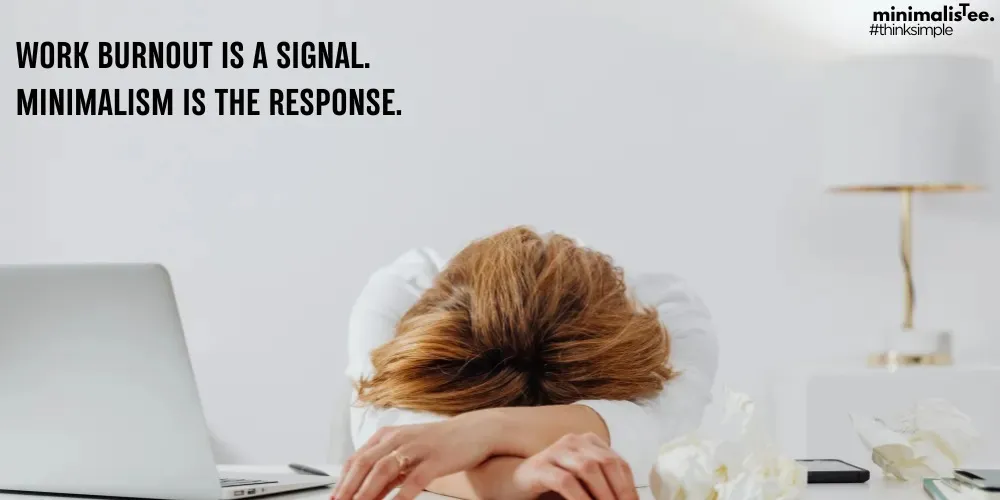
Work burnout doesn’t arrive loudly. It doesn’t knock or announce itself; it slips in quietly.
That feeling of being “on” all the time but never really being fully present. That constant feeling of tiredness, irritation, or even that sense of not being able to feel belonged at times.
Most of us are taught to respond to work burnout with more effort, more discipline, and more pushing. But what if burnout isn’t asking for more?
What if it’s asking for less?
Work burnout is not a personal failure.
Sadly, for many young professionals, burnout feels confusing. That constant comparison with peers and the need to prove yourself at every quarter or annual meeting can be too much of a pressure for many.
The truth is, most of us don’t even realise something isn’t right until it is too late.
You have a decent job, and you know you are capable. You are even doing what you are “supposed” to be doing. And yet those moments slowly creep in, making you doubt your worthiness and question your career choices. Because when burnout at work shows up, the instinct is to blame yourself.
But burnout isn’t a sign of weakness. It is instead your body giving you a signal, information, that what you are feeling isn’t random or a failure of your capabilities.
It’s your mind and body saying, “Something in your life is too crowded.”
The hidden cause: Too much, all the time
Work burnout rarely comes from one bad day. Yes, contrary to what many young professionals think, burnout doesn’t happen because of one bad project or one missed deadline.
The truth is, when you have to constantly do “too much” all the time, it takes a toll on your physical and mental health. And all these “too much” slowly add up to create that big exhaustion bubble, which bursts one day and makes you go insane.
When too many tasks that don’t really matter and too many expectations to be always available start pressuring you, your brain starts signalling distress. You think you can play multiple roles at once and easily manage all those urgencies and comparisons all the time. But the truth is, it only ends up creating a full calendar, leaving your brain exhausted and energy empty.
And by all means, this isn’t a lack of motivation at play, but an overload problem, which we choose to ignore.
Where does minimalism enter (gently)?
Minimalism here isn’t about owning fewer things or having a perfectly aesthetic life. It’s about making subtractions with intention, and consciously owning those decisions.
What does work minimalism ask us to focus on?
- What actually deserves my energy?
- What can be simplified, paused, or removed?
- What am I holding onto out of guilt, fear, or habit?
Minimalism doesn’t push you to quit your job or abandon ambition. Instead, it helps you declutter and clear out space so that your ambition can breathe. It makes you focus on what’s necessary for your growth and minimises all the distractions that aren’t adding value to your life.
So, how does minimalism respond to burnout?
Here are a few ways in which minimalism helps tackle work burnout in a simple but practical way.
1. It creates fewer priorities, clearer focus
Instead of trying to do everything, minimalism helps you identify what truly matters today. It helps you understand your priorities and focus your energy on what deserves your attention, and reduce the clutter of what’s unnecessary.
2. It creates boundaries that protect energy
Work burnout can make you feel guilty when you are unable to commit the way you used to. But minimalism helps you create a reasonable boundary to safeguard your space and well-being.
Minimalism gives you permission to:
- Log off without guilt.
- Say no without overexplaining.
- Stop treating urgency as importance.
3. Reduces invisible work
So much burnout comes from emotional and mental labour of being available, responsive, and “on” all the time.
Minimalism asks: Where can I stop overextending?
And trust me, you do not have to present all the time for everything to prove your worth.
4. Rest without earning it
Most of us were taught a quiet rule growing up: rest can only come after everything is done. Unless we meet our deadlines or finish our tasks at hand, we don’t prove our productivity or efficiency, and that shouldn’t allow us to rest.
As a result, rest becomes conditional, like a reward that needs to be earned through exhaustion.
But that isn’t where rest begins; it is where work burnout begins. And minimalism reminds you that you don’t have to exhaust yourself to deserve a break. You pause because you are human, not because you finished your “tasks” for the day.

It’s basically choosing recovery as part of the process, not the end of it.
Bonus: Signs that work burnout is asking for a minimalist response
Here are a few quick signs that tell you that you are going through burnout at work (and haven’t realised it yet):
- You feel busy but disconnected from your work or team members.
- Rest makes you feel guilty, and you are constantly worried about completing pending work.
- Small tasks feel overwhelmingly difficult to finish, even though you could easily do them a few months or years back.
- Work spills into every part of your day, and there aren’t any clear boundaries between when you are working and when you aren’t.
- You fantasise about escape from a task or a meeting, but not growth or achieving a milestone.
These aren’t signs of laziness, but signals of saturation. You start attaching your worth to output and stop treating exhaustion as proof of effort.
But this won’t get you very far. Burnout is a signal that something needs to be simplified and not fixed, and the sooner you start accepting this truth, the quicker you start growing truly.
Minimalism as a career skill
Yes, in a world that rewards constant output, minimalism can become a quiet strength for you. All you need to do is intentionally let it flow into your life.
Minimalism helps you:
- Work sustainably and mindfully.
- Make clearer decisions at work.
- Avoid burnout cycles and do not ignore them.
- Build a career that actually evolves with your life.
Minimalism doesn’t shrink your career. Instead, it gives you the space to have a liveable work environment.
A gentle place to start
So, how can we start implementing these changes in our work-life? See, you don’t need to make massive changes in your life or switch your job to start enjoying it. All you need to do is start making small but significant changes that will help you understand what’s helping you grow and work more intentionally.
You can start by:
- Removing one unnecessary meeting from your to-do list.
- Setting one clear boundary, such as no-work lunch hours or no-talk focused work.
- Let go of one draining obligation.
- Protect one hour of uninterrupted time.
Remember: Sometimes the most powerful career move is subtraction.
Closing thought
Do not treat work burnout as your enemy. Take it into account as a message that is trying to notify your system that this pace is costing you your peace and energy.
Minimalism isn’t about doing less for the sake of it. It’s about doing what matters, without losing yourself in the process. And that might be the most sustainable way to work and live.
This blog is written by Ayesha Mollah, a professional blogger who has embraced minimalism since 2023. Being on the minimalist journey is helping her find her "focus" amidst the chaos.